Friday, October 3, 2008

A review of Islamic revolution- Part 8

** Please scroll down or check the links on the right side of the page for previous parts **

After completing his trainings, which included taking part in execution of a number of Syrian officers who were accused of activities against Asad’s government, Story of Mr. Shafizadeh continues in new direction with his return to Paris in the year 1977. In Paris, he meets Sadegh Ghotbzadeh, Abolhassan Banisadr and Hassan Habibi who had come to airport with Gholambabbas Tavassoli to welcome him. This is when he becomes involved with Ghotbzadeh who, develops very close relationship with Jafar Shafizadeh and becomes his new mentor outside Iran. A new phase in the life of Jafar starts after that in which, he moves to Libya along with Mr. Ghotbzadeh to learn some new skills but before I get to that, let’s take a look at Sadegh Ghotbzadeh to see how he got there and what was his relation with Islamic revolution.

In order to understand how Sadegh Ghotbzadeh became a major role player in preparation for Islamic revolution and what was the nature of his relations with Shafizadeh, Khomeini and others, we need to take a look at Ghotbzadeh’s life and his family background. There are not many sources available to provide detailed information about family and life of Mr. Ghotbzadeh because he was not well known in Iranian politics and not many people have spoken about him. The best available source about this unusual figure, which I could get my hands on, is a book written by his last girl friend, Carole Jerome, a Canadian journalist who used to work for CBC. Carole Jerome has done some research on Ghotbzadeh’s life after he was executed by Khomeini and published that as part of a book that she wrote about Islamic revolution in 1987, named “The Man In The Mirror”. When I received this book from a friend the next year and read it, my first impression was that the author probably had exaggerated about the importance of Ghotbzadeh’s role in the revolution under influence of her feelings for him but when further information came out from other sources later on, proved this to be wrong.

Sadegh Ghotbzadeh was born to a bazaari family whose father Hussein Ghotbzadeh had friendship with Dr. Mohammad Mosadegh through common business interests in farming sector. According to Sadegh himself, he spent about two weeks with Dr. Mosadegh after he was released from prison to help him with some issues related to the trees in his Ahmadabad properties. Sadegh was about 10 years old at that time. Ghotbzadeh’s family, like most others of the same class in Iran, were religious but according to him, they were not too fanatic about their religious belief. As a result of his familiarity with late Dr. Mosadegh he developed a lot of sympathy towards Dr. Mosadegh and felt angry towards Shah. “Sadegh explained that he had grown up hating the Shah, yet his was not red-faced anger.” Carole Jerome says in her book.

Sadegh runs into trouble with Iranian police for anti-regime activities when in his early 20’s and is released after spending a night in detention. After that, his father decides to send him out for his studies. Ghotbzadeh moves to United States and after a couple of years, he is ordered by immigration office to leave. According to his girl friend Carole, the reason was his anti-Shah activities and his low grade average in the school. Ghotbzadeh had entered in “Confederation of Iranian Students” (CIS in short) right after he entered United States. This was a couple of years earlier than the time that an Iranian student had claimed that CIA had tried to recruit him for CIS. This matter became a big issue and caused some unpleasant reactions by Iranian government and the Shah, which was settled with Mr. Alam's and Mr. Ardeshir Zahedi’s intervention without getting to the Iranian national media. American embassy blamed it all on “Communists” who were trying to sabotage the relations between the two nations by accusing that student being in contact with East Germany’s government. From the strong reaction by late Shah himself, one may think that there had been enough justification for Iranian government to believe in credibility of the student’s claim. Mr. Zahedi had an interesting conversation with U.S. ambassador over this issue, which is partly reflected in embassy’s letter to State Department.

Ghotbzadeh left U.S. for France and shortly after, he came back with a Syrian passport with a name, which was slightly different. Not much longer his real identity was discovered by U.S. authorities and he was ordered to leave again. He contacted Robert Kennedy whom he had met before but he could not help Ghotbzadeh that time. After some struggles, he received an admission to enter a Canadian university in British Columbia to finish his studies in history and receive a BA degree. Ghotbzadeh then moved to France again and with the help of Banisadr, Nobari, Hassan Habibi and Ebrahim Yazdi (who worked with them from U.S.), created “Muslim Students Organization” in early 1970’s because they believed that CIS had been infiltrated by communists. This was right after the tension between U.S. government and Iran over the involvement of CIA in CIS.


*** Part 1 of the documents which show how Iranian security agency or SAVAK could successfully identify the main source which was behind CIS that was established in United States. US embassy denied any connection between American CIA and CIS and expressed their unhappiness over such development ***


Other than Iranian friends, Sadegh Ghotbzadeh had a large number of powerful and influential friends among middle eastern nations and in Europe. He had a team of French lawyers as friends who helped him through out his revolutionary activities and he also had strong friendship with known figures like Hafez Al-Asad of Syria, Qadhafi of Libya, and Yaser Arafat of PLO. He was so close to PLO that when PLO representative, Mahmoud Hamshahri was killed in Paris in 1972, Ghotbzadeh took care of PLO office until a new rep was dispatched by Arafat, the leader of PLO. Ghotbzadeh’s address for his passport was in Demascas (Syria), Avenue Jole Jamal while he was in constant communication and meetings with PLO leader Arafat in Lebanon and Qadhafi in Libya. Carole Jerome says in her book: “The Newsweek article by Arnaud de Borchgrave said that French Intelligence sources reported that Ghotbzadeh had "direct connection with the heads of the Communist party in France and Italy, and that he worked closely with Libyan Secret Service.". And of course Ghotbzadeh always denied that.

Carole Jerome also mentions that French DST (one of French security services) had reported Ghotbzadeh as an agent of Qadhafi as he had been followed to Tripoli by another French Secret Service (SDECE) and met Qadhafi and Libyan agents there. MOSSAD had also confirmed this information and reported that Ghotbzadeh had gone to Geneva after he left Tripoli and opened an account into which five million dollar was deposited.

In another part of the same book we read: “During the 1970’s Sadegh traveled widely on behalf of the revolutionary movement from Kuala Lampur to United States, always under watchful eyes of SAVAK, the DST, the CIA and the FBI. Oddly, he was now able to visit the United States on tourist visas, but on occasion he went with false identification from his collection of passports. When his luggage mysteriously vanished for long periods at American airports, he was unconcerned, knowing full well who was inspecting it.”

When Ghotbzadeh had entered US with Syrian passport in 1967, Immigration service rejected his application for student status and State Department cancelled his visa, which was issued in Paris. When Ghotbzadeh went to State Dept with his lawyer, Geoff Keating on his side, one of the officials just showed them a five-inch thick file while screaming at them that how they expected to deal with that file. Carole Jerome says when she managed to take that file under Freedom of Information Act 4 years after Ghotbzadeh's death, all the information except the name and description of Ghotbzadeh was still blacked out and nothing could be found. Carole Jerome says when Keating had asked Ghotbzadeh what was in the file he had replied: "The usual".


Ghotbzadeh was so close to Qadhafi that he could see him anytime he wished. Cheron, Ghtobzadeh’s lawyer told Carole Jerome that after Musa Sadr went missing, Ghotbzadeh went to see Qadhafi to ask about that. He did not disclose anything to his friend and lawyer, Cheron, but told him that he believed that Qadhafi had killed Sadr.

Ghotbzadeh had met Musa Sadr in Paris for the first time through Sadegh Tabatabai, Sadr’s nephew and later had meetings with him in Beirut where he also met Mustafa Chamran. They discussed the issues related to PLO and Lebanon in their meetings where Arafat also attended sometimes. Ms Jerome mentions that Qadhafi who considered himself champion of pan-Arabism and muslims unity provided financial support to Musa Sadr and other groups who worked in that direction but states that Ghotbzadeh did not trust Qadhafi and did not agree with his views. Musa Sadr was also in contact with Iranian government and SAVAK and when Qadhafi discovered this matter, killed Sadr without ever admitting it. The mystery around Sadr’s disappearance after he apparently left Libya for Italy was never resolved.


*** Part 2 of documents related to CIS and US government attempt to blame it on communists. ***


Ghotbzadeh also met Dr. Shariati in 1970 in a group meeting with Banisadr, Nobari, and Habibi. Shariati advised the group to send Ghotbzadeh to meet Khomeini in Najaf because he believed that Khomeini was different than other mullahs. Ghotbzadeh met Khomeini and his son Mustafa in Najaf and did not like Mustafa who was trying to control his father’s activities. Ghotbzadeh suspected Mustafa of having negative influence on Khomeini but Khomeini told him not to worry about him. According to Carole Jerome, Mustafa favored armed rebellion and this troubled Ghotbzadeh. Mustafa told Ghotbzadeh: “My father will kill more than the Shah could he imagine to realize his dreams.”. Ghotbzadeh learned about Khomeini’s “Islamic Republic” directly from him in Najaf.


When Shah vetoed the idea of Khomeini being expelled from France French government informed Ghotbzadeh that he had to leave. Ghotbzadeh’s lawyer, Vallette contacted Claude Chayet of French Quai who met Ghotbzadeh and then contacted ministry of interior and withdrew that order because he believed that Khomeini would take over the government in Iran and did not want to have bad relations with future officials of Iranian government.

In regards to delay in Khomeini's departure from Paris after Bakhtiar declared that he would not allow Khomeini's plane to enter Iran, Carole Jerome writes:
"Sadegh contacted a friend who, in turn, sounded out his old acquaintance, The American ambassador to UNESCO. In this way, he avoided contacting the American administration directly. Sadegh was then put in touch with Irving Brown, officially the representative of the AFL-CIO (American Federation of Labor-Congress of Industrial Organizations), but less officially the representative of Central Intelligence Agency, according to a friend."

“To show how Ghtobzadeh was close to Khomeini, speaking of Ghotbzadeh lawyer friends (Bertrand Vallette and Francois Cheron) Carole Jerome writes: "One day they discovered a slight squirt in the man from Qom. Sadegh announced that he had to pick up some cologne for Khomeini. 'He likes Christian Dior stuff, Eau Sauvage,' Sadegh told Cheron who hooted in laughter.
'Khomeini? Christian Dior?' Cheron managed to sputter.
Sadegh was defensive. 'Well, why not? There's no law against smelling nice. You know Khomeini's wife, Batool?'
'Not personally' Cheron answered.
'She spends most of her time in Paris shopping for Dior dresses,' Sadegh revealed.
'I didn't think the budget ran to things like that. She must be very elegant under her chador. It seems a waste.'
'She is' Sadegh replied. Then for Cheron's edification, he launched into defense of chador". Carole Jerome writes.

This behavior of Islamic revolutionary elements and their families in Paris is inline with the behavior that Mr. Shafizadeh has given detailed information about that in his book. Same kind of behavior is reported by Mr. Hussein Broujerdi after revolutionaries entered Iran and this matter became the main reason for defecting of these two and many other individuals who were too close to center of revolution and witnessed all those disgusting and nauseating behaviors from leaders of a Islamic revolution who had come to rescue them from moral corruption.

The same French Lawyers worked in association with Christian Bourget to help Ghotbzadeh in arresting and returning Shah to Iran through negotiation with Panamanian government in 1980.


to be continued...


Next part click here


A review of Islamic revolution- Part 7

One of the saddest realities about Iranian political establishment and leadership, since the time that presence of westerners was increasing in Iran during Ghajar/Kadjar dynasty, has been the tendency for corruption among the people of highest ranks while many Iranians at the lower social classes were more loyal and committed to their country. Since more than two hundred years ago, Iranian territory became an attractive and easy target for super powers which had come with little or nothing but expected a lot and, there have always been those who were willing to sell the nation out by collaborating with them for personal gains. Another issue which has been source of many problems for our nation has been failure due to ignorance and immaturity of educated Iranians and Iranian intellectual community which should have had shouldered some of the responsibilities in leading the nation towards better judgment of its national and political interests. Despite a lot of work which, had been done in a relatively short period of time during Pahlavi era to train a new generation of statesmen by sending groups of students to be educated and become familiar with modern societies, many of same educated people became tools to destroy all the hopes of our nation for better future.

From those, there were some who held high positions within the system and also some who were outside the system but did their best to destroy it with help of external foes. It is obvious that the destructive effects of first group was a lot greater than second while the second group would never be able to accomplish much without existence of the first group. So many years have passed from those chaotic days and many things have come to light. Today almost everyone knows about the extent of effect of obscure figures like General Fardoust as an internal element who worked against the system while holding a very sensitive position in it. It is important to know that he was not the only person in highest positions in previous regime who covertly worked against the system in collaboration with the foreign governments who had interest in destroying that system while pretending to be friends and trying to be helpful.

Ofira Seliktar, an Israeli scholar and political scientist in her book about Iranian revolution, “The Failing of Crystal Ball Test” quotes a statement from William Sullivan, the last ambassador of United States to Iran saying: “there were ‘those’ in State Department ‘who were so strongly opposed to the Shah because of human right abuses of his regime that they wished to see him collapse no matter what the consequences for United States and its allies.’”

Knowing a little about history of relations between United States and other nations and remembering the stories of American meddling and invasions in different parts of the world, from Vietnam to Cuba, from Korea to Chili, from Grenada to Panama and many other places, this passive statement by Mr. Sullivan about Iran with such huge strategic values as a country to the north of Strait of Hormuz and Persian Gulf where more than two third of non-communist world energy and more than 90% of NATO’s energy needs pass through, can only be interpreted as a joke. This argument about importance of Iran in the politics of the west becomes more clear when we look at the geographic location of the country to the south of the Soviet Union where United States had setup major surveillance stations for constant monitoring of Soviet activities. All of this can tell us that United States and its allies were absolutely certain that Shah’s departure from Iran, not only would not weaken their position in Iran but also will provide them with a more devoted and less annoying allied regime which its leaders would be happy to have their hands on enormous wealth which they did not even dream of earlier.

Interestingly enough, Mr. Sullivan in his cable communication to Washington regarding coming of Khomeini to power suggests: “.. if the Shah fell and Khomeini took over, all was not lost.” . Carole Jerome, a journalist who accompanied Khomeini in the plane to Iran and the author of The Man in The Mirror continues: “His assessment was that the new government would be staunchly anti-Soviet and that Khomeini would remain a Gandhi-like figure. The main drawback was that Iran would become anti-Israeli. 'Thinking unthinkable' he called it."

Was it really “thinking unthinkable”? Was it possible that American policy makers did not know about teachings of Khomeini even though they had kept interest in him since 1963? Mr. Sulivan in his book, “Mission to Iran” states that he spent a few weeks on studying a variety of issues about Iran before leaving for Tehran. According to Mr. Sullivan, he conducted a comprehensive study on possibility of a “change” in Iran’s behavior towards Americans. He checked and contacted all American companies, which were in some sort of business with Iranian government. Mr. Sullivan asked all of them to be prepared to reduce the number of their employees and even leave Iran all together. This matter was very strange to some of the companies, which were involved in projects like manufacturing of military equipments and their maintenance in Iran but the advisory was very clear and they had no choice but to abide. As part of his studies, Mr. Sullivan had made assessment of loss of investments by American companies and designed solutions to reduce those damages. Mr. Sullivan also contacted some of the opposition elements in United States without mentioning any name. All of these and much more are documented in black and white and can only give us this impression that, despite some of later statements by Mr. Sullivan, U.S. government was not venturing in unfamiliar territories by supporting Khomeini.

There is one more point that I would like to mention here before moving on to other stories from inside the revolution. Carole Jerome who had spoken to William Sullivan quotes him in her book (The Man in The Mirror) that in a meeting with Shah: “….the Shah angrily launched into a ten-minute harangue. He listed each of the marches, demonstrations and strikes that had taken place, concluding, '...This cannot be the amateur work of spontaneous opposition. All the evidence indicate sophisticated planning.' The Shah turned to face Sullivan. 'And I have decided that it must all be result of foreign intrigue. What bothers me is that this intrigue is far beyond capabilities of KGB. It must therefore involve the British and American CIA'”. After that, Shah expressed his confusion over sudden turning of CIA against him while Sullivan provided some incomplete information about demonstrations and how they were funded and blamed it all on bazaaris. Mr. Sullivan then concluded that Shah was paranoid but overwhelming evidences are available today, which can confirm the Shah's suspicions at that time.

Carole Jerome who worked for Canadian Broadcasting Corporation (CBC) was appointed to her position in Paris during mid 1970’s when she was 26 years old. She met Sadegh Ghotbzadeh a few years later for the first time and her love story with Ghotbzadeh coincided with the time when Islamic revolution was close to its final stages. Around the same time that Carole moved to Paris, a young Iranian butcher lived in a village around Najaf-abad of Isfahan called Ghahderijan. His name was Jafar Shafizadeh and he ran his father’s butcher shop for living. According to his memories, which have been organized and published by late Siavash Bashiri (1), his life turned upside down one day, when he was asked by Mehdi Hashemi, a loyal, respectful and generous customer for a favor in exchange for a considerable pay in summer of the year 1975. That favor was, to help Mehdi Hashemi with reception for a party of some friends from ranking clerics in an obscure location while keeping this matter from everyone including his own family.

The offer was too tempting for Mr. Shafizadeh to pass as he was a young uneducated villager whose dream was just to have a nice butcher shop with enough revenue to support him and his parents. The money that Jafar received from Mehdi Hashemi for two weeks work was beyond his imaginations. He did not even make that money in the whole year. During the two weeks, he saw all the guests, which included eleven mullahs and four non-mullah people. He did not know anyone of them at that time but later he found out who they were as they all took important positions in the Islamic revolution which had entered a new stage in that summer day of the year 1975. The most important figure in that crowd was none other than ayatollah Beheshti. Others included: Mohammad Montazeri, Javad Bahonar, Sadegh Khalkhali, Fazlollah Mahallati, Ayatollah Taheri, ayatollah Khademi, ayatollah Saneii, Sadooghi Yazdi, Dastgheyb Shirazi, Meshkini and four non-mullah: Dr. Salavati, Dr. Minachi, Gholamabbas Tavassoli, and Mohammad Hashemi Rafsanjani. Ali Akbar Parvaresh, a close associate of Mehdi Hashemi, was also present. This meeting took place a year after late Shah was diagnosed with mild Lymphoma and a year before massacre of ayatollah Shamsabadi and his family in the same village.

From that point on Jafar Shafizadeh, a simple young and talented villager with very limited education, entered a circle, which took him through events that he could never imagine before. In this new phase in his life, Jafar met many people who would hold highest positions in revolutionary government later, and visited many places that he never thought of previously. After the meeting ended, Mehdi Hashemi paid Jafar handsomely, and told him to get ready to go and get his passport next morning, without waiting for his agreement. Next day, Hashemi told him that he will be sent to an important mission and all his financial concerns will be taken care of and there should not be any problem. Jafar who, according to himself, would even kill anyone if Mehdi Hashemi asked him, became special servant for Mr. Hashemi after that and drove him around town while Mr. Hashemi, a devoted Muslim who even performed sermon in some religious sessions, took care of his own business and continued to pay Jafar generously.

Sometime after Jafar’s passport was ready, him and Gholamabbas Tavassoli departed for Paris and after a few days in Paris, Jafar was given a closed envelope and directed to airport to go to Syria where he was received by some Syrian military personnel and taken to a camp. Along with a few dozens of other people from different Islamic nations, Jafar received special training for guerrilla combat activities. Many of the people in that group were Iranians and all of them had higher education than Jafar. Some of them were university students or have completed their university. It was one of those days in training camp when Jafar was given the news by one of Syrian officers about arrest of Mehdi Hashemi and some of Shafizadeh family members for killings of ayatollah Shamsabadi and his family.

to be continued..

A review of Islamic revolution- Part 6

Some of declassified communication documents of US embassy in Tehran indicate how seriously Americans were concerned about relations between Iranian government and the consortium in which American companies had gained a big share since 1953. In this document, American embassy gives detailed account of Shah's plans for oil after 1979 and clearly mentions the threatening statement of American ambassador which indicated that if the problem was not resolved to the satisfactory of oil companies then there would be problems between Iran and the home countries of the oil companies (which were none other than UK and US). This document alone shows how US government acted as representative of oil companies to push their agenda through show of muscle while in many other occasions denies having any influence over decisions made by those companies. If we believe that then it means that US government, in its relation with other nations, is always acting as protector of some companies which, in the views of US government, their interests is the same as the interests of United States. Whether this is a fair behavior towards the interests of American tax payer or not, is something which should be dealt with by American people who are always wondering why people in other parts of the world don't like them so much! 


A review of Islamic revolution- Part 5

In an interview with VOA in March 2008, Hossein Faraji, a former staff of Iranian National Radio and TV who worked as member of Persian broadcasting service in “Deutsche Welle” of Germany, spoke about Sadegh Ghotbzadeh. Mr. Hossein Faraji said that he knew Ghotbzadeh from school years when they were classmates and was surprised when he called Paris one day to speak to someone named “haji Sadegh” and the person who spoke to him turned to be no one but Sadegh Ghtobzadeh, a friend from school days. Mr. Faraji had been given mission by his office in Germany to go to Paris and see the Khomeini’s camp up close and prepare a report. He was invited by Ghotbzadeh to go to Paris and, when he went there, he could see that Ghotbzadeh was the most influential person in the circle of people around Khomeini in Paris and everyone came to him if there was any issue.

Let’s leave Ghtobzadeh here as we will be talking about him a lot more but for now, let’s go back a few years to look at the source of some issues which had severe effect on Iran-US relations so that the idea of an “alternative” solution to Iran’s “problems” became very attractive for American governments of both parties.

Growing needs for funding different development plans after initial success of the 1963 reforms under name of “White Revolution”, had created an urge to find new resources and more capital to support such growth. Some people claim that late Shah was “inspired” by American government during J.F. Kennedy to implement such reforms but this is very far from truth. While American administrations, including Kennedy’s, have always had certain demands from Shah in the name of “reform” but there has never been a blue print for such reforms other than recommending use of certain people (i.e.: late Dr. Amini) to form the government. During Amini’s government, Mr. Arsanjani, the minister of agriculture initiated a land reform program, which faced strong resistance by big Landowners and caused a lot of problems for the government. At the same time mishandling of educational system by Mr. Derakhshesh, minister of education, had caused a lot of problems in the country resulting in widespread dissatisfaction with government, that was growing very fast.

Absence of the parliament, which was dissolved by Dr. Amini in the beginning of his government as a precondition for him to form the government, had created a chaotic condition with large deficit and increasing unemployment and other problems, that was getting out of control quickly. As a result, Dr. Amini was dismissed and Asadollah Alam replaced him. About a year later, Shah introduced his own reform with 6 articles which became known as white revolution later. The reform bill was put to referendum and approved by the people. A few months later Khomeini declared his opposition to the reforms and confrontation of Khomeini’s followers with government began.

As reforms moved forward, the government came under more pressure to find new resources to fund different plans. US government which apparently supported reform programs was not willing to provide any more funding even during Dr. Amini’s government. Iran had no choice but to push for more revenue from oil companies and this matter became increasingly annoying to US government. Even though they told Iranian government that they did not have any control over oil companies but continuously advised Iranian government to exercise moderation in their negotiations and requests from oil companies to avoid any issues because otherwise Iran’s relations with the US government would be affected! From the other side, while refusing to accept Iranian oil through a government to government deal, they advised Iran not to seek such solution with others either because they won’t be able to market their own oil so Iran had no choice but to sell its oil through the oil consortium.

The oil problem in relation between Iranian and US governments was so severe sometimes that in one case even a possible “showdown” with Iranian government, over its request for $1 billion verses $900 millions which consortium had accepted, was debated in state department! Iranian government of course was not aware of this matter while counting heavily on friendship of United States and its leaders but they finally got what they wanted and even more. In year 1971, Henry Kissinger, the National Security Advisor to President Nixon, had a conversation with the Shah that was reported by American embassy as follows (which shows the degree of trust that Shah had in Americans):

“Dr. Kissinger asked whether the Shah felt the people of the Near East needed to fear some sort of US-Soviet deal that would work to their disadvantage. The Shah said he did not feel so because the US is not the kind of nation to sell out its friends.”

This conversation happened during the times which Iranian government was vigorously working to increase its revenue from oil exports for funding ambitious industrial developments and expansion and modernization of its military. Intense negotiation with oil consortium had caused even some unfriendly exchanges between Shah and US embassy over the concerns of United States regarding supply of oil to NATO and European allies. United States government always stressed on continuous flow of oil to the allies and more importantly, the NATO and at the same time recommended that development plans to be implemented in slower pace to avoid “issues”.

Shah had his own reasons not to comply with that request while pressing Americans for more advanced military equipments but from the communication documents of US government, it was obvious that this story could not continue for long.


to be continued...

A review of Islamic revolution- Part 4-1

Part of US Ambassador's report in 1972 in response to a request by State Department after celebration of 2500 years of Iranian monarchy. I will make more images available later. A variety of issues are discussed in this report which includes detailed information about Iranian military strength and also about views of Shah regarding presence of American forces in Persian Gulf which has been one of the sources of tension in Iran-U.S. relations.


Thursday, September 4, 2008

A review of Islamic revolution- Part 4

Multiple and comprehensive intelligence reports by American embassy and CIA in Tehran provided US government with detailed information about the mood of society especially, the young generation towards current conditions in the country. These reports indicated increasing tendency towards religious sentiments among young Iranians while emphasizing incompatibility of “democracy” with current level of understanding of the concept among them. University students were mentioned as a symbol of this change in mood towards a more religious society. From what we can see in the reports, the intelligence study has been mostly conducted in Capital City of Tehran and in a part of this report we read:

“A constant theme in the desires of involved youth is for a more "democratic" state. However, they are not able to specify what this implies for Iran, other than generalized statements about greater "freedom" and openness. Democracy is an alien concept in Iranian history; it is a western invention that, without considerable change and adaptation, is not really relevant to the needs of Iran. However, the young people of the country see the affluence and freedom of their western peers and believe that the adoption of a similar political system will result in the same perquisites in Iran.”

A bit further in the report we read about growing Islamic sentiments among youth who prefer “traditional” way of living and “consider women just an object of beauty which, belongs to bed” that has been clarified earlier in the same report:

“There has been a noticeable and unexpected growth of .interest in religion among a small segment of the youth of Iran, especially those studying and teaching in the Universities. The Islamic students union is strong on all university campuses and attendance at the Tehran University Mosque is continually increasing. The increased interest in religion is basically conservative in nature and a reaction against Westernization, rather than a positive renaissance of religion on the campuses. A small number of students have also embraced religious orthodoxy as a means of criticizing the Shah and 1-1 4.s method of rule in Iran. Criticisms of the Shah which might be unacceptable in a secular context, can often be voiced under cover of an interest in strengthening the role of religion in Iranian life.

The vicissitudes of Western technology and the inroads made by Western culture have led many students to turn to religious conservatism and orthodoxy as a reaction against the trials of modernization and urbanization. Consequently, the growth of religious consciousness is not expected to lead to renewed interest in a Pan-Islamic movement among Iranian students or faculty. Not only does the usual Sunni-.Shi f ite split militate against the growth of Pan-Islamism in Iran, but the basically conservative, inward-looking, anti foreign basis for the revival of interest in religion in Iran among the young educated classes precludes the new interest from becoming a positive force for modernization or change in the country. It is necessary to re-emphasize that this growth of interest is on a small scale and affects • an extremely limited percentage of the student body. It is interesting, however, as an indication of one of the possible paths reaction against Westernization and modernization can take in the Iranian society.”


It is obvious by now that the “possible path” for the society which, was noticed by American intelligence among Iranian youth on a “small scale” became the actual path which, ruined not only the future of our nation, but also became a menace for the region to create a rush for western conventional armament so that during years of 1990 to 1994, a third of conventional arms produced in the world to be sold to three countries of Persian Gulf (Kuwait, UAE and Saudi) with a value of $67 billions. The report looks at the implications for foreign policy of United States:

“IMPLICATIONS FOR U. S. FOREIGN POLICY The attitudes of Iranian youth are important to our policy toward Iran because there is every indication that these attitudes will persist even as youth grows older. Even those who join the system and appear to be co-opted often have in fact, submerged rather than abandoned their earlier feelings. The attitudes which this report has discussed at length may be summarized for the present purpose as follows:

1. Acceptance of or resignation to the present situation, for the time being.

2. A strong yearning for . democratization, civil liberties, and a general opening and freeing of Iranian life.

3. A desire among a substantial portion of Iranian youth not to see the Pahlavi dynasty - with its present power .... continue after the present Shah, even though the concept of a Monarch who reigns but does not rule, has broader acceptance.

4. A powerful urge for greater national self-respect, independence, and realization of identify. If, as is our premise here, we must have a greater sensitivity to these feelings , whether open or covert, in Iran's future leaders , our assets in so doing are the admiration of young Iran for American ideals and democracy and for the openness, vitality, and dynamism of our society and our national life. Our hindrances are the very close identification of the United States with the Shah and with both the structure and the methods of his rule.

There is no noticeable feeling among young, urban Iranians that the United States encourages, or even approves in principle of, democratization in Iran. Instead there is a general feeling, that the United States prizes democracy for itself, but regards Iranians as a people unable to implement democracy, and in any case finds a totalitarian regime in Iran easier to work with or to manipulate. A number of possible events in Iran including the actual achievement of gradual democratization, could bring to positions of real power persons who had acquired these attitudes toward the United States in their youth. It is therefore imperative that we attack the bases of these attitudes wherever possible.”


As it can be seen from these few paragraphs, according to this report, Iranian society is not compatible with democracy for it is a “western invention” and has no relevance to the “needs of Iran” but in conclusion, it complains because Iranians can see through it! Through out history of relations between Iran and United States, especially during Kennedy era, US government has been putting a lot of stress on reform and even, in one occasion, insist on appointment of Dr. Amini as Prime Minister in order to carry out required reforms. But at the same time, US politicians did not agree with Shah’s argument about introduction of democracy in Iranian society in a slower pace and after educational and social reforms matured, while in this intelligence report they talk about “gradual democratization” which is unclear how. One may think that the authors of such intelligence reports are either extremely confused or trying hard to distort the truth about some issues.

In the same report, the “circles” of Iranian elite and how people got into this circle has been thoroughly studied and educated Iranians who were absorbed in this circle after their return from western nations in order to participate in the process of progress are labeled “opportunist” because they just integrated themselves in the system and thought of nothing but making money. In one report in 1972 Khomeini is compared with religious leaders of Constitutional revolution by stating that, the religious leaders of Constitutional revolution supported the reforms to limit the power of Shah in 1906 and Khomeini opposed the reforms that increased the power of Shah in 1960. The year 1960 of course seems to be incorrect as the actual confrontation between Khomeini and Iranian government over the suggested reforms by Shah happened in 1963.

From this statement, one may think that the reforms were about increasing the role and power of monarch through legal means and creation of new laws but in reality, all the articles of reform were related to social and welfare issues to help the move towards equal spread of wealth, health and education in the society and getting Iranian women more involved in the politics of the nation. It is interesting to know that internal opposition to Shah (mainly Tudeh party and Jebhe Melli) were trying to discredit these reforms as a show with no real effect which had been ordered by Washington because Kennedy administration was pressing the Shah for social reforms while US government, in their secret communications, considered them a tool to increase Shah’s power that Khomeini was opposed to! Portraying Khomeini like a true revolutionary champion for the cause of justice who attempts to fight the power of a dictatorial monarch is not limited to this document.


A couple of years earlier, American embassy in a report after death of Ayatollah Hakim in 1970, shows a lot of interest in the role of Iranian government in keeping Khomeini away from becoming the leader of Shi’ite world while, according to the embassy, he enjoys strong support among “Ulama” and “bazaaris”. It is unclear how American embassy has come up with that conclusion at that time while activities on behalf of Khomeini in bazaar was not evident until a few years later near late 1970’s. Even today, “Iran studies” book in the library of US congress (http://countrystudies.us/iran/) is propagating the same kind of information about Khomeini’s status among Iranians in early 1970’s:

“Khomeini, in exile in Iraq, continued to issue antigovernment statements, to attack the shah personally, and to organize supporters. In a series of lectures delivered to his students in An Najaf in 1969 and 1970 and later published in book form under the title of Velayat-e Faqih (The Vice Regency of the Islamic Jurist), he argued that monarchy was a form of government abhorrent to Islam, that true Muslims must strive for the establishment of an Islamic state, and that the leadership of the state belonged by right to the faqih, or Islamic jurist. A network of clerics worked for Khomeini in Iran, returning from periods of imprisonment and exile to continue their activities. Increasing internal difficulties in the early 1970s gradually won Khomeini a growing number of followers.” 


Dr. Musa Al-Musavi-Esfahani, the son of grand Ayatollah Musavi-Esfahani and an Ayatollah himself, had spent a lot of time with Khomeini while in Najaf. In his interviews with Shahla Haeri in Harvard Oral History Project of Iran, Ayatollah Musavi-Esfahani says that Khomeini’s older son, Mustafa insisted on keeping his father away from politics through controlling all his meetings with those who came to visit him. Dr. Musavi-Esfahani has explained how Khomeini was later dragged back into political activities after Mustafa died. He claims that the people who were interested in this matter included Ahmad Khomeini and Mohammad Montazeri who was in contact with Libyan government. This issue raises another question about the death of Mustafa, which Mr. Musavi-Esfahani believes has been inspired by Ahmad Khomeini himself. Later in revolution days, it became clearer that both Mohammad Montazeri and Ahmad Khomeini had close relations with Sadiq Ghtobzadeh who was also in contact with Libyans and had received financial assistance from Libyans for his revolution!

This will remind us about the main and fundamental question on what mysterious force was at work to gradually pave the way for Khomeini to move to center stage even in presence of someone like Ayatollah Khoee who was the official “Pishva” of Shi’ite (as American Embassy refers to it)? From the murder of Ayatollah Shamsabadi and his family members to death of Mustafa Khomeini to disappearance of Musa Sadr in Libya and forcing Khomeini out of Iraq to go to Paris, there must have been a lot of “coincidences” involved in span of a few years to brew a “Islamic Revolution”.

To be continued..

A review of Islamic revolution- Part 3

Activities of Islamic groups like "Fadaian Islam" (or devotees of Islam) against Iranian government goes back to the days of Kadjar dynasty in which they assassinated Naser-ol-din shah of Kadjar through directions and teachings of seyyed Jamal-o-din Asadabadi (or Afghani), who was also known for his attempts to create a establishment with Islamic ideology in Egypt called Islamic Unity Front, in order to unite all Islamic nations. Seyyed Jamal was a mysterious character who had visited many places in and out of the region and had also spent some time in England where he became familiar and stayed with important British figures there.

Even though seyyed Jamal was not successful in Egypt but, he managed to create the foundation of a movement through his students which was later established by Hassan al-Banna and became known as "Muslim Brotherhood" while "Fadaian Islam" practically started with him as a mentor. Fadian Islam carried out many other assassinations through out their history which one of them was assassination of Hassanali Mansour, a technocrat who became Prime Minister in Iran before late Amir-Abbas Hoveyda.

Another Islamic group which was founded more recently in Iran was "Motalefeh" which was made mainly by bazaris and Islamic clerics form which most of them were from Tehran and Isfahan region. This group proved to be more deadly and radical in their views and actions than others. In their first known violent move in cooperation with "Fadian Islam", Motalefeh killed ayatollah Shamsabadi through one of their supporters, Mehdi Hashemi, around Isfahan. This murder was carried out over differences between two groups of clerics regarding a book called "shahid-e javid" (or "Immortal Martyr") which was denounced by ayatollah Shamsabadi while Khomeini and his staunch followers including ayatollah Montazari had praised it. "Immortal Martyr" was a new version of Imam Hussein's story written by a cleric from Qum and speaking against that was considered as opposition to Khomeini whom some of high ranking mullahs were trying to promote as universal leader of Shi'ite sect.

"Immortal Martyr" promoted violent revolt of imam Hussein against Yazid as a doctrine for worldwide struggle against injustice which later became subject of teaching by people like Dr. Shariati in his books and places like "Husseiniye Ershad". Ayatollah Shamsabadi had openly argued against it as a tool to create difference in Islamic world and put Shi'ites against Sunnis. He was condemned to death by a group of mullahs and non-mullah supporters of Khomeini who would have a part in creation of Islamic Republic later on. This event took place in 1976 and Mehdi Hashemi, brother of ayatollah Montazeri's son in law was arrested shortly afterwards and jailed to be freed during revolution days in 1979. Mehdi Hashemi who was a wealthy farmer was also involved in drug trades and had done a lot more for Islamic revolution and Islamic movement in Lebanon, Palestine and Syria prior to this event. He was the connection between Ghtobzadeh and internal elements of Islamic movement and flow of money from bazaaris to Khomeini was mostly through him. Hashemi's arrest by SAVAK did not lead to any more arrest which indicate either a soft approach on this issue (for whatever reason) by SAVAK or lack of will to move in that direction because otherwise, many people who were involved in making the original decision about that murder would end up in cage instead of plotting for revolution a couple of years later.

While the grounds for Islamic revolution was being prepared by supporters of Khomeini in Iran which also had infiltrated the government agencies, relations between Iran and western nations with leadership of United States, despite apparent sincere and public exchanges, was not in greatest shape because of disagreements over the issue of oil. Declassified documents of communications between different US government divisions clearly indicate a double face policy regarding oil dispute between Iranian government and oil consortium. In these documents we can see how US government always advised Iranians that they have no control over the oil companies while expressed concern that lack of cooperation between Iranian government and oil companies may cause deterioration of relation with United States and other western nations! United States even rejected the suggestion by Shah to buy Iranian oil directly at cheaper price in exchange for US products in order to make sure there will be no balance of payments with the excuse that these matters should be done through private contractors according to US laws while they had same arrangements with Canada and Venezuela at same exact time!

Multiple documents reveal that United States also had great concerns over close relations between Iran and Soviet Union and had warned Iranian government over that while ignoring Iranian government's information regarding upcoming "changes" in Afghanistan and possible take over of that country by a Soviet friendly government. Iran's negative position towards the situation in Bahrain regarding replacement of British forces by Americans in 1972 and insisting on the role of Iran and Saudi Arabia in taking the security of the Persian Gulf in their own hands was viewed with suspicion even after Shah expressed his agreement of keeping a small presence of American forces as a deterrent in the face of heavy activities of Soviet Union in Indian Ocean. US government was aware that their strategic national and security interests in Iran had been effectively used as a balancing factor by Iranian government against Iran's relation with Soviet Union and to push for more support from United States. While US government took advantage of the information provided to them about the region through Shah, the increasing influence of Iranian government which became more evident as time passed, and also ambitions of Shah to make Iran a regional power and an important element in politics of the world through use of the wealth earned from selling oil, was not very pleasant to them.

After US government terminated their military grants to Iran in 1964, Iran continued its dependence to US military equipments for its military expansion programs which was to support industrialization of the nation as far as security and also to enforce Iran's international rights and guarantee her territorial integrity in case of any aggression by surrounding nations. Total military purchases of Iran from United States was about $11.2 billion from year 1950 to year 1979 from which about $10.7 billion was delivered and from that about $1.4 billion was part of US military grants to Iranian government. Most of the military purchases were based on credit with an interest of 6.25% while the rest was paid for in hard cash. During the years that Iran was making those military purchases, the economic growth continued to be one of the highest in the world ranging from 8% to 12%, which indicate a healthy economy.

During these years, Shah continued to press oil consortium for more revenue to satisfy the funding needed for different development programs and expansion of military might while western observers and politicians always raised concerns over the speed of development programs and the magnitude of military purchases. Increasing presence of Soviet Union in Iran through economic agreement over steel mill project and also purchase of military equipments from them which, required contact between Iranian military officers with Soviets, caused some worries for US officials. US government became concerned about compromising the security of the secrets of their advanced military technology that Shah had requested for, or at least, they expressed such concerns even if it was just an excuse for grievance.

Through out those years, while US government tried to use the policy of "carrot and stick" to exert control over Iranian government by linking the availability of their military aid requested by Shah to cooperation of Iranian government with consortium, they found themselves in a situation that same policy was played on them through "independent foreign policy" of Iran under which Iranian government implemented their diversification policies in the field of military and economy. Shah in his communications with US officials always stressed that Iran was counting on friendship of US government in case if Soviet Union aggression against Iran but he insisted that it would not be wise for Iran to depend on US to come to his assistance for example if Iraqi government decided to make some problems for Iran. In response to what he would do if US did not or was not able to help Iran in case of Soviets aggression, Shah said that he would use the policy of "scorched territory" if he had to in case Iranian forces could not deter the enemy.

There is ample amount of documents to suggest that international oil consortium used security of flow of oil from Persian Gulf as an element of pressure especially on Iranian government through western nations, to curb their demands for increasing revenue from oil. NATO with 90% of its oil consumption coming from Persian gulf was one of the most important interested parties as far as continuous and secure flow of oil from Persian Gulf. US government predicted the demand for oil in western world, including NATO, would grow quickly in future and showed a great deal of sensitivity towards the negotiation between Iranian government and oil companies with a tendency to support the oil companies. During these years, the question of "change" in Iranian government and future of Iran after Shah became an issue of concern for US government and a comprehensive intelligence research was initiated to study the possible outcomes if Shah disappeared and in one occasion, in 1971, US state department asks American embassy in Tehran 
to clarify what would happen if Shah was assassinated or died of a sickness.


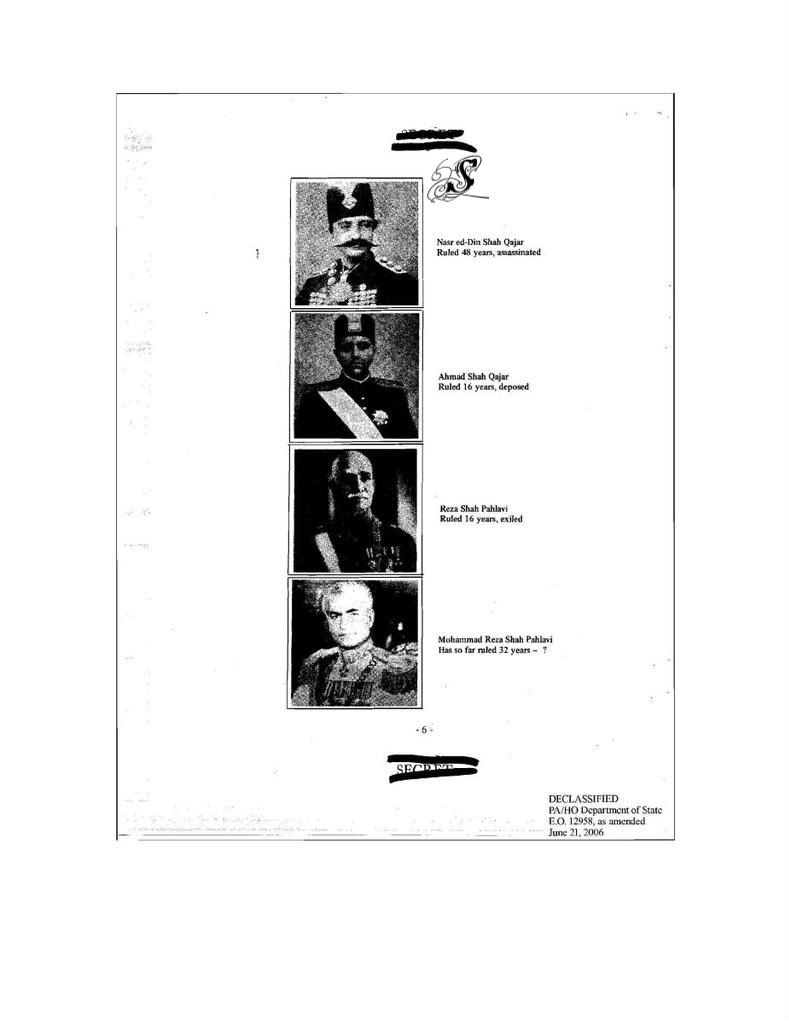
Comparison of Reza Shah the Great and Mohammad Reza Shah the Great with two Kadjar kings from which one went to exile and other was assassinated (above), and comparison of Khomeini with high ranking mullahs during Iranian Constitutional Revolution (below).


To be continued....